Site tour
The Top 5 day
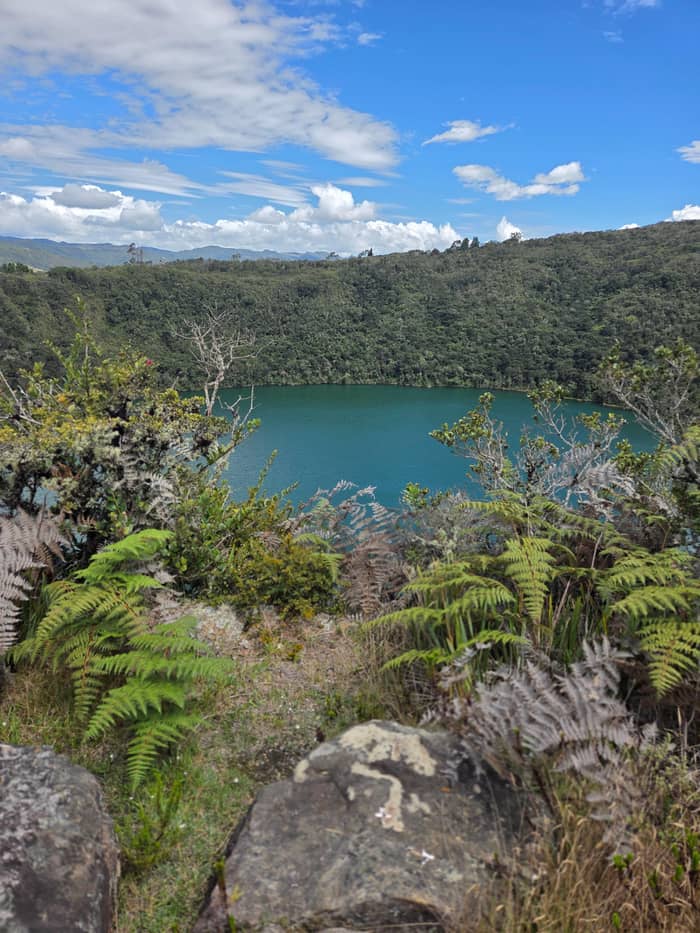
Lake, town and salt cathedral
- Day12 hours from Bogota
- Lake time2.25 hours with a guided hike
- GuideEnglish and Spanish
- CancellationFree up to 24 hours ahead
Estimate your group cost
Brief answer
The Lake Guatavita gold of the El Dorado legend was a ritual offering, and the lake was drained by tunnels that recovered far less than the story promised.
Legend in brief
Weigh up 3 options
Type in your party and see each shared fare added up.
≈
View≈
View≈
ViewStarting prices as on the booking platform, converted at the ECB reference rate. You see the exact price at booking.
Lake Guatavita gold has a real story: the chiefs' ceremony behind the legend, the tunnels dug to empty the lake, the gold that came out and where the raft is kept.
Editorial team, lakeguatavita.quest · Updated November 24, 2026 · 9 min reading time
Facts at a glance
Strip away the treasure-hunt reputation and El Dorado at Lake Guatavita in Colombia begins as an investiture. Chroniclers described a ceremony in which a Muisca cacique was acknowledged as the new chief, and it included sailing out on a raft and throwing gold pieces and emeralds into the lake.1 The lake was the stage, but Colombia's tourism promoter says it was also a place where people worshipped Chie, the goddess of water.2 Read that way, the gold was an offering to a deity long before it was anything else.
The preparations were staged like theater. Along the water's edge stood 4 braziers, and the incense burned in them sent up smoke thick enough to hide the daylight.6 Priests then undressed the chief and coated him with a sticky mixture of soil and gold powder, and he boarded the raft with large amounts of gold and emeralds piled at his feet.7 Anyone standing on the rim today, looking down at a small round lake in cold mountain air, can place that scene easily.
The climax was short. When the raft reached the center of the lake a flag went up as the signal for silence, and the new chief threw himself into the water together with his offerings.8 The colonial writer Juan Rodriguez Freyle added that 4 principal caciques rode the raft with the new lord, dressed in feathers and gold, each carrying an offering of his own.9 So the raft carried a small delegation of rulers, which is a more interesting picture than a lone man glittering in the sun.
What the accounts say
| Attempt | What happened | Reported result |
|---|---|---|
| Captain Fonte | The first try at draining the lake | Stopped for lack of funds.10 |
| Perez de Quesada | Water level lowered by about 10 feet | 3,000 to 4,000 pesos of fine gold.11 |
| Sepulveda | Royal contract under Philip II | More than 12,000 pesos from the shores.12 |
| Paris and 16 partners | Tunnel begun in 1821 | Collapse, many workers dead.13,14 |
| Cooper and Contractors Limited | Tunnel 400 m long, lake drained | Gold worth 500 pounds, emeralds about 70 pounds.4,21 |
The figures are as the geographical society's article reports them from chroniclers and visitors, so they are period claims, not audited totals.11
Most people who think they have seen the Lake Guatavita ceremony have really seen a small gold sculpture in Bogota. The Muisca raft measures 19.5 cm in length, 10.1 cm across and 10.2 cm in height, which surprises visitors who expect something the size of a canoe and have to lean in close to the glass to read the tiny figures.15 It was cast as a single piece by the lost wax method in a clay mold, in gold of more than 80% purity mixed with silver and copper.16
The little figures are what make it a map of the rite. A central figure, believed to be the cacique, stands among 12 smaller figures, and the smallest of them sit at the edges as oarsmen.17 The Gold Museum of the Banco de la Republica says the piece was found in a cave on La Campana hill in Pasca, Cundinamarca, by Cruz Maria Dimate and her son in 1969, and that the bank bought it the same year.5 An honest label therefore reads: found near Pasca, associated with the Guatavita ceremony.
That last point is worth repeating, because the legend tends to swallow it. The tourism promoter states plainly that the raft was not found in Guatavita.18 The museum adds that the raft belonged to a larger offering that included a seated-figure vessel, a small ceramic lime container, fragments of a feline skull and a gold chieftain carried in a litter.19 The ceremony and the object are linked by a tradition, not by an excavation record at the lake.
The legend traveled before the conquistadors did. In the account that a Jesuit scholar wrote for the national geographical society, the story was told to the conquistador Belalcazar in Quito by a Muisca visitor, and his reaction is recorded as a call to go and look for this golden Indian.23 From that moment the ritual stopped belonging only to the Muisca and became a rumor that Europeans carried from town to town, growing with each telling until a golden city seemed to wait somewhere in the mountains.
Gold really did go into the water in quantity, according to the chroniclers. Fray Pedro Simon wrote that the cacique of Simijaca alone threw 40 loads of gold into the lake, carried there by 40 men from his town.24 The figure comes from a chronicle and should be read as a claim of the period, not as an inventory. Even so, it shows how large the offerings were in the memory of those who wrote about them.
For the visitor, the useful point is that the legend mixes a Muisca ritual, with its water goddess and its offerings,2 and a European obsession with gold that the ritual provoked. Walking the guided loop around the rim, it is worth keeping them apart: the first explains why the lake was sacred and why the guide asks you to be quiet, and the second explains the tunnels and the mud-diggers that came later. Both belong to the same hillside, and a visit is richer when you hold them in your head together.
Pick your angle
Match what you are curious about to a row and see which part of the trip deserves your attention.
If I want the ceremony told where it happened
Take the guided loop
The reserve lets you walk only with a CAR guide, so the story comes with the route.
If I want to see the golden raft itself
Plan a museum stop in Bogota
The raft is displayed in the capital, not at the lake, so a lake day alone will not show it.
If I want the lake and the colonial town together
Pick a day with a town stop
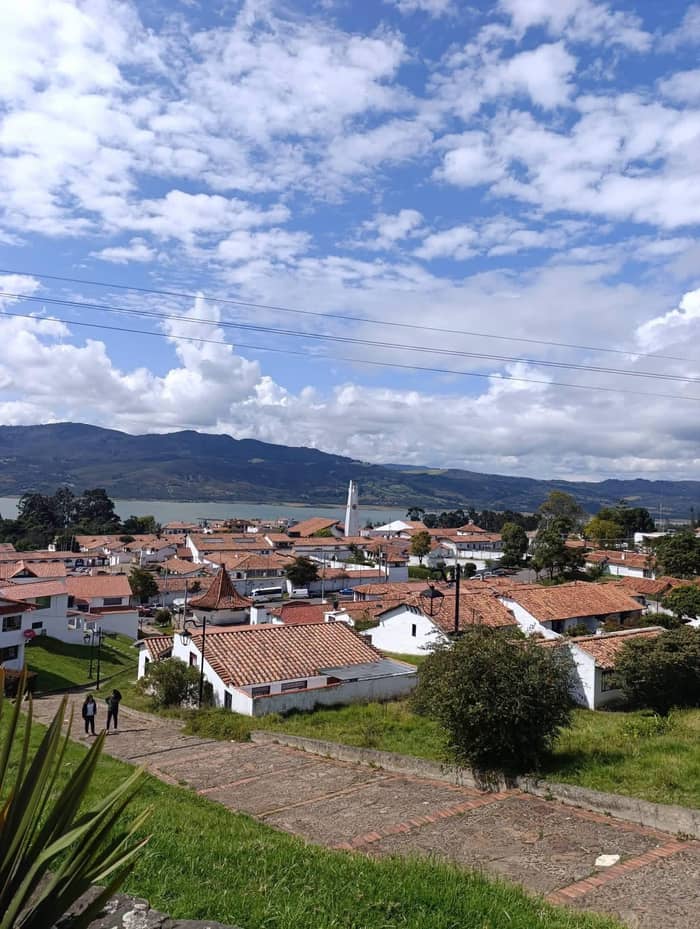
Several listed days pair the lake with a walk and lunch in the new town.
If I want the story told only to my group
Look at a private day
A private listing lets your own group set the pace at each stop.
If I want to know what is left in the lake
Read the sources, not the myth
The accounts report modest hauls, so the honest answer is that nobody can prove more remains.
If I feel the cold at altitude
Dress in layers
The lake sits high in the mountains and stays cool through the year.
Hear it on the spot
Site tour
Lake, town and salt cathedral
Legend focus
Private, lake and town
Small group
At most 5 people
Draining a lake in the Andes with colonial tools was a project that kept failing for the same reason, which was money. Colombia Travel says the Spaniards tried several times, gave up because of the cost, and recovered very little of the gold.3 The same article names Captain Lazaro Fonte as the first to try, in the early years of the conquest, and records that he abandoned the work for lack of funds.10
Hernan Perez de Quesada did better. He managed to lower the water by about 10 feet, yet he took out only 3,000 to 4,000 pesos of fine gold.11 Later Antonio de Sepulveda contracted with the crown of Philip II to drain the lake, and Rodriguez Freyle wrote that more than 12,000 pesos were taken from the shores of the section he emptied.12 Neither result matched the legend, and both men were left with a lake that was still deep.
The Bogota city government, repeating information from the regional authority, sums up the whole series of attempts in one dry sentence: only a few objects were found.33 The summary is brief, but it fits what the detailed accounts say about the size of each haul. Scientists studying the basin put numbers on the damage: between 1830 and 1935 the floor was disturbed by at least 4 drainings.34
The story in order
The ceremony
A raft, gold powder and emeralds, and a flag for silence at the center of the lake.8
First attempt
The first try at draining the lake ends for lack of funds.10
Quesada
The work yields only 3,000 to 4,000 pesos of fine gold.11
Sepulveda
More than 12,000 pesos are taken from the shores he drained.12
Paris
The English years
A tunnel 400 m long drains the lake and Cooper's workers dig the mud.4
After independence the work became a business. Jose Ignacio Paris began a large drainage project in 1821 with 16 shareholders, and it cost 20,000 dollars instead of the 8,000 that had been planned, with 33 feet of water still to drain.13 His tunnel then collapsed, many workers died, and the project of the shareholders came to an end.14 The sums look small today, but they show how a treasure legend can swallow a budget.
The English attempt was the one that worked. By July 1910 Lake Guatavita was drained, and two German visitors inspected the tunnel, 400 m long and 2 m high, that had done it.4 The Englishman in charge, W. Cooper, had been at the work for 8 years.35 Men dug in the mud with picks and shovels, earning 35 pesos a day plus a bonus for each find.36 A 1911 photograph by Beisswanger shows the lake completely drained, and the morphometric study reproduces it.37
The company behind the work was Contractors Limited, and its profits turned out to be smaller than what it invested, which is the kind of ending the legend rarely mentions.38 Cooper told his visitors that the gold found since 1909 was worth 500 pounds, and the emeralds about 70 pounds.21 For a legend of a golden city, that is a modest haul. The war of 1914 and a lack of funds ended the venture, and the lake was left to fill again with water and silence.38
Video
Archaeological Context on YouTube · The video only starts loading on your tap.
offerings were acts of care for the world and were deposited in caves, lagoons, and other places that allowed a connection with the sacred
At the lake
Put the figures from the different attempts side by side and the pattern is clear: effort was large and the haul was small. The early Spanish efforts yielded thousands of pesos at most,11 the Cooper years yielded gold worth hundreds of pounds,21 and the regional authority's summary is that only a few objects were found.33 The treasure of the legend is more convincing in the imagination than in any account of what came out of the mud.
Some real pieces do survive in public hands. Colombia Travel says part of the El Dorado treasure is now in the collections that the Bank of the Republic has recovered over more than 60 years and shows at the Gold Museum in Bogota.39 The museum's own explanation of the raft changes the question: in Muisca practice an offering was a way of caring for the world, and it was left in caves, lagoons and other places where the sacred could be reached.22 On that reading the lake was a place of exchange, not a vault.
There is also a sister object that shows how common these rafts were. A gold raft carrying 10 human figures, weighing 262 grams and 9.5 cm across, was taken from the Siecha lake in 1856.20 The museum's updated display of the Pasca raft reopened on 20 December 2024 with new narratives that put the offering context first.32 Both facts point the same way: the legend is bigger than any single lake, and the objects that survive were made to be offered, not to be displayed.
Nobody can answer that with certainty, and the sources are candid about it, which is refreshing in a subject that attracts so much hype. Colombia Travel says it is impossible to prove whether any Muisca treasure remains at the muddy bottom of the lake.40 What can be said is that the lake was emptied by a tunnel and searched in the mud by paid workers.4 Treat any claim about a precise number of tons still resting down there as storytelling, since no source in the record supports one.
The lake itself is not a vault either, whatever the legend suggests. Sonar work puts the deepest point at 30 m, the average depth at 12.7 m and the water surface at 114,017 square meters.41,42,43 The numbers describe a modest pond by tourist-brochure standards. A body of water that size has been dredged, drained and walked around for centuries. Today the lake sits inside a protected reserve, and the park rules prohibit drones, so nobody is flying over it to count rings on the surface.28
So the practical answer for a visitor is to go for the story and the setting. The reserve runs guided loops that last about 2 hours on average, with departures every 15 to 20 minutes.26 A good guide will place the raft, the braziers and the tunnel for you in sequence, and the day tour from Bogota that includes the lake gives the visit a time slot of 2.25 hours. That is enough time to feel what the Spanish and the English were chasing, without the mud. On the practical side, you stay with a CAR guide,25 pay in cash,27 and leave food and drinks outside the gate,31 while the Kusmuy adds more of the Muisca tradition29 and your ticket should stay in your pocket.30
FAQ
Colombia Travel says it is impossible to prove whether any Muisca treasure remains at the muddy bottom of the lake, and the lake was drained by a tunnel and searched by paid workers.40
The Gold Museum says the raft was found in a cave on La Campana hill in Pasca by Cruz Maria Dimate and her son in 1969.5
Cooper said the gold found since 1909 was worth 500 pounds and the emeralds about 70 pounds.21
The renovated exhibit of the raft reopened at the Gold Museum of the Banco de la Republica on 20 December 2024.32
Sources
Planning a day at Lake Guatavita? Ask a real person here.